
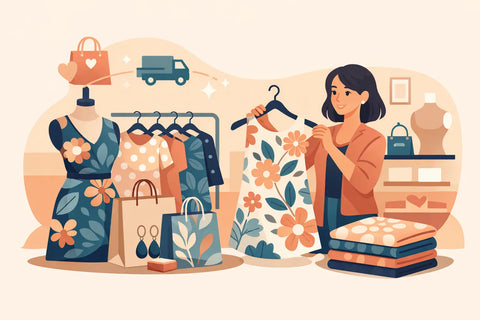
Why Printed Boutique Clothing Still Wins
A great print can do what a whole outfit sometimes can’t - start the conversation, set the mood, and make getting dressed feel a lot more fun. That’s the real pull of printed boutique clothing. It has personality baked in, but the best pieces also bring shape, quality, and point of view. They do not just look different on a rack. They wear differently in real life.
That matters because shoppers are getting sharper. Nobody needs another forgettable top, another generic dress, or another graphic that feels like it came out of a giant trend machine. People want pieces that feel chosen. A bold floral, an offbeat abstract, a punchy stripe, a playful motif - when it’s done right, print gives clothing energy without making it hard to wear.
What printed boutique clothing does better
Boutique fashion has always had an edge when it comes to curation. It is not trying to please everyone at once, and that is exactly the point. Printed boutique clothing tends to stand out because it is selected or developed with a clearer perspective. The print is part of the story, not an afterthought added to a basic silhouette.
That shows up in a few ways. First, there is usually more intention behind color. Boutique prints often feel fresher because they are tied to a mood, a season, or a very specific aesthetic point of view. Second, scale gets more attention. A tiny ditsy print and an oversized graphic floral send two very different messages, and strong boutique assortments understand that. Third, the silhouette actually matters. A print on the wrong cut can feel busy fast. On the right cut, it clicks.
This is where boutique shopping beats the endless scroll. The goal is not to bury you in options. It is to show you the right ones.
The sweet spot between statement and wearable
There is a reason printed pieces keep cycling back, even when minimal dressing is having a moment. Prints bring movement to a wardrobe. They break up the flatness of solids and give you a way to show taste without overstyling.
Still, not every print earns closet space. Some are all impact and no longevity. Others are so safe they disappear. The sweet spot is a piece that catches your eye now and still makes sense a year from now. That might be a printed blouse with strong color balance, a camp shirt with a clean fit, or a dress with an artful pattern placed where it flatters instead of overwhelms.
It depends on how you dress. If your wardrobe leans neutral, printed boutique clothing can be your accent - one standout item with denim, tailored trousers, or simple layering pieces. If you already dress with more confidence, print can be the anchor of the look. Either way, the piece has to earn its keep beyond one photo or one event.
Why print placement matters more than people think
A beautiful print can still fail if placement is off. This is one of those details people notice without always knowing why. When the pattern fights the seam lines, stretches oddly across the body, or lands awkwardly at the bust, hip, or shoulder, the garment loses polish.
Better boutique clothing usually handles this with more care. Print placement is considered alongside the pattern shape, drape, and cut. A bias-cut skirt in a fluid print gives a very different result than a boxy woven shirt in the same fabric. The best versions respect both the artwork and the body.
For shoppers, that means looking beyond the print itself. Ask whether the scale suits the silhouette. Notice whether the pattern enhances the garment or just fills it. A striking print is good. A striking print on the right shape is where the magic happens.
Small-batch design changes the feel
One of the biggest advantages of boutique fashion is that it often comes from smaller runs and tighter edits. That changes the relationship you have with the clothing. You are not wearing the same mass-market print seen everywhere for six months straight. The piece feels more personal, more collected, more like your own find.
That small-batch mindset can also improve quality control. Teams working closer to the product can pay more attention to color consistency, fabric choice, and finish. Not always - boutique does not automatically mean better - but the potential is there, especially when design and production are connected instead of split across a long, impersonal chain.
Printed boutique clothing and quality are not separate conversations
Print gets attention first, but fabrication is what keeps the piece in rotation. A killer pattern on stiff, cheap fabric usually ends up hanging in the closet. A smart print on the right material becomes the one you grab again and again.
This is where the stronger brands pull ahead. They think about hand feel, drape, washability, and wear. A printed mesh top should feel different from a printed cotton poplin shirt. A satin set should move differently from a structured twill jacket. If everything is designed as if print alone will sell it, the result feels flat.
There is also the question of how the print is produced. More shoppers are paying attention to sourcing, labor, and waste, and rightly so. A beautiful garment hits differently when it is backed by responsible production standards. Ethical manufacturing, fair wages, and thoughtful development are not side notes anymore. They are part of the value.
For brands building collections, this is especially true. A good print may get a first order, but quality and consistency earn reorders.
For shoppers: how to buy prints you will actually wear
The easiest mistake is buying for the rush of the print and ignoring the rest. If you want printed pieces that keep performing, start with your real habits. Are you dressing for weekend plans, work, travel, events, or everyday wear that needs more personality? The answer should shape what kind of print you buy.
A printed matching set can be high impact, but it may split into even more outfits if each piece works separately. A printed midi dress can be effortless if the fit is right, but less versatile if the neckline or sleeve makes layering difficult. A printed button-down can go casual or polished depending on fabrication. There is no single best category. There is only what fits your life and your style rhythm.
It also helps to think in terms of print roles. Some pieces are lead singers. Others are the band. A bright conversational print might be your event piece. A softer stripe, geometric, or tonal floral might be your weekly workhorse. Both belong in a strong closet.
How to style without overworking it
The best thing about a strong print is that it reduces how much else you need. Let the garment do the talking. Clean denim, simple jewelry, solid shoes, and one intentional layer are often enough.
If you like more edge, pull a color from the print and repeat it in a shoe or bag. If you want the look to feel more relaxed, pair the print with texture instead of more color - washed denim, broken-in leather, soft knits, or crisp cotton. Print mixing can work too, but the trick is contrast. Change the scale, keep one color story in common, and stop before it turns chaotic.
For brands: printed boutique clothing needs development discipline
From the business side, printed boutique clothing is exciting because it gives a collection identity fast. A memorable print can become a signature, spark social sharing, and help a brand feel more ownable. But it also raises the stakes. Development has to be sharp.
Print scale should be tested on actual garment patterns, not just judged on a screen. Sampling matters because a print that looks balanced in a flat layout may shift completely once cut and sewn. Fabric testing matters because color saturation, shrinkage, and drape all affect the final result. This is where real product development experience separates brands that look polished from brands that look almost ready.
Small labels especially benefit from getting this right early. A tight print edit with strong fit and thoughtful production will usually outperform a larger assortment of half-resolved ideas. Fewer pieces, better executed, has real power in boutique retail.
That is also why businesses that understand both merchandising and manufacturing bring something different to the table. Blank Canvas Showroom sits in that lane naturally - equal parts style, strategy, and production know-how - and that mix matters when the goal is not just to sell a print, but to build a product people come back for.
Why these pieces keep earning their place
Printed fashion has never really been about being louder. It is about being more specific. The right print tells you something about the person wearing it and the brand behind it. It can feel playful, polished, offbeat, romantic, sharp, nostalgic, or straight-up bold. That range is exactly why it lasts.
When boutique prints are chosen well, cut well, and made with care, they do more than freshen up a rack. They bring the fun back to getting dressed while still holding up to real standards of quality and wear. If a piece can do that, it is not extra. It is essential.